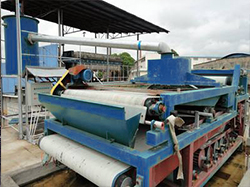
Sludge thickening and dewatering is two important stages in treating sludge. Thickening is the first step of sludge treatment in which the solids concentration is increased and the total sludge volume is correspondingly decreased, Thickening commonly produces sludge solids concentrations between 15% and 20%, LZZG Deep Cone Thickener results in maximum water recovery, maximum underflow density, can help to save the downstream costs.
Dewatring process reduces the most moisture content of the sludge. LZZG use filter press(mechanical dewatering) for dewatering. Separate liquids and solids utilizes the principle of pressure drive, after the mechanical dewatering process, the sludge will results in a 95% reduction in volume, which will be convenient for storage and transportation. Most overflows will be recycled or reusing.
Sludge treatment system is imporatant in treating solid waste. It minimizes the water waste, enabling the re-treatment of sludges so that they can be easily stock or landfill.
LZZG sludge treatment system is consist of Deep Cone Thickener and Filter Press, The systems usually used after sand washing machine, dewatering screen, tailing dewatering screen or sand recycling machines, widely applied for wastewater treatment of sandstone aggregate plant, precious metal dressing plant, ceramics, glass and other industries.
As a solid-liquid separation equipment, the filter press has a long history in the application of materials dewatering and liquids solids separation. Specifically, the slurry is pumped into the filter press chambers. Under the action of the pressure pump, the filter plates extrude each other, so the low moisture content cake is formed and released.
LZZG customized filter presses feature good separation effect and wide adaptability, especially for the sticky and fine materials. Whether you require a high capacity of Filter Press or a smaller footprint design, we will design best option standard or specific filter press solutions for each user based on the volume and type of slurry that needs to be dewatered.
As a professional filter press manufacturer, LZZG's extensive range of industrial filter presses, including plate filter press, belt filter press as well as a range of optional equipment accessories: automatic filter cloth cleaning system, auto plate shifting device, auto plate shaking device, automatic hydraulic device, and PLC auto-control, etc.
How to classify aggregates | Types of Aggregates.
Aggregates are variously classified on the foundation of their grain size, their origin, and their volume-weight as follows:
1.Aggregate Types on the foundation of Grain Size.
This is the most common classification, the place in two sorts of aggregates are distinguished: (Fine and Coarse).
(1) Fine Aggregates.
In the Fine Aggregates, the grain-size lies between 4.75 mm and 0.15 mm.
(2) Coarse Aggregates:
Coarse aggregates are those that are retained on the sieve of mesh dimension 4.75 mm.
2.Types on the Basis of origin.
There are three kinds on the Basis of Origin.
(1) Natural:
These include all these types of first-rate and coarse aggregates, that are reachable in nearly prepared to use form, from herbal resources.
(2) Bye-product:
These encompass materials obtained as wastes from some industrial and metallurgical engineering operations, which possess appropriate residences for being used as aggregate.
(3) Processed:
These structure a specific class in Aggregate. They are especially manufactured for use in making Quality Concretes.
3.Types on the Basis of Density.
Three kinds of aggregates are individual on the groundwork of their weight per unit volume.
(1) Standard or Normal:
These kinds of aggregates supply strength and weighting to the Concrete of around two 2300 to 2500 kg/m3.
(2) High-Density Aggregates:
These are that kind of Aggregates, which is used in fashionable proportions yield in heavy weight concretes.
(3) Light weight Aggregate:
They consist of herbal and artificial materials of very low density so that the resulting concrete is also pretty Light in weight, usually with in a vary of 350 to 750 kg/m3.
LZZG Belt filter presses are designed for dewatering applications where sludge is particulate, include various types of industrial wastewater sludge, such as sand-making mud, washed sand mud, mine tailings, piling mud, river silt, etc.
They are pumped to the deep cone thickener, the flocculant is added to the thickener tank, and the concentration of the sludge in the thickener is increased by 60%-70% under flocculation and gravity precipitation.
Then sent to the belt filter presses, under the action of a gravity zone, a wedge zone, and a pressure zone , the sludge cake with water content of less than 20% is formed and the overflow clean water will be re-processing.
What is sand washing machine? Sand washing equipment is utilized to expel the residue and stone powder in the sand created by sand making machine, it likewise can do sand-choosing work or the comparable procedure. The machine expects to enhance the quality and grade of the sand.
The screw sand washer is for the most part utilized for sand preparing, electric post industrial facility, building work site and solid dam, different sands arranging and dewatering.The screw washer embraces tendency of 15°,under the water tub, three weir plates frame the dregs pool, the fasten head is drenched this pool, the screw is driven by electric engine through reducer pivoting persistently, the crisp water is sustaining from permeable plate at base of silt pool, this machine have three elements of washing, dewatering, characterizing. The screw sand washer application: Screw classifier can successfully seperate the mud among the material and clean the coal and sand. The materials are passed on to the assigned positon while cleaning and drying as the sprial mixes. winding sand washer is outstanding for its strict triple fixing framework, which ensures the soundness while pocessing.
screw washer is perfect for cleaning troublesome material. Extreme insoluble muds, combinations and delicate stone, and certain established totals are too hard to even think about cleaning appropriately in ordinary screw machines. The log washer altogether scouring, separates, and cleans the hardest materials. These high caliber, exceptionally sturdy machines perform well under the hardest dirt conditions with least power, water and downtime. How can it function?
The electric engine runs gradually with the impellor after decelerated by the belt, decelerator and gears wheel. The sand and stone stream into washing wash from sustaining wash, moves with the impellor, and granulates one another. The contamination covering the sand is washing ceaselessly. In the meantime, include more water, the solid water stream will remove waste and some low-weight squanders from washing wash. Through the above procedure, the washing capacity is done. The spotless sand and stone is lift up by vane. When it goes up gradually, the water starts to drop through the work and fall back in the washing wash. Fundamental Features of Screw Type Sand Washer
1. Basic structure, the impeller bearing is detached from water, significantly to keep the bearing because of flooding, sand and toxins lead to the harm.
2. There is little misfortune for medium-sized and fine sand or fine stone powder. The item is met to national principles, for example, "sand for development".
3. There is no other wearing part with the exception of the screen work.
4. Long administration life and multiple times for upkeep.
Dewatering, Liquid-Solid Separation, Classification, Thickening & Water Recycling
Dewatering & Liquid-Solid Separation
In the processing of aggregates, frac sand, coal and other industrial minerals, Belt filter press has proven reliable and efficient in the dewatering process and liquid solid separation.
Whether it's coal plant refuse dewatering, aggregate and mineral tailings dewatering, sludge and residuals slurry separation, or sludge dewatering for municipal and industrial wastewater treatment systems, Belt filter press have a variety of liquid solid separation and dewatering process technology.
Industrial waste product treatment plants ar designed to satisfy pretreatment water needs before downstream WWTP municipal facilities and / or turn out clean, safe water for direct discharge at intervals the desired limits.
Because the needs for cleaner discharge waters increase thus will the sophistication of commercial treatment processes being designed and engineered these days. And, bottle centrifuges ar being extensively used additional and additional for liquid- solid separation, sludge dewatering, and sludge thickening applications as a part of these pretreatment and / or kit and boodle operations.
Belt Filter is a broadly applicable product for dewatering municipal Biosolids and industrial sludges. Dewatering, Liquid-Solid Separation, Classification, Thickening & Water Recycling Technologies.
Belt Filter Press is a sludge dewatering device that applies mechanical pressure to a chemically conditioned slurry, which is sandwiched between two tensioned belts, by passing those belts through a serpentine of decreasing diameter rolls.
The machine can actually be divided into three zones: the gravity zone, where free draining water is drained by gravity through a porous belt; the wedge zone, where the solids are prepared for pressure application; and the pressure zone, where medium, then high pressure is applied to the conditioned solids.